
The B7 chord shows up everywhere: blues turnarounds, classic rock, folk standards, jazz cadences. Yet plenty of players stall on it because it asks for clean fretting across awkward finger combinations and fast transitions. If you’ve been dodging B7, this guide will help you make it dependable on both guitar and ukulele—without brute force.
What B7 actually is (and why it matters)
B7 is a dominant seventh built on B: the notes B, D#, F#, and A. In practical terms, this chord pulls strongly to E major or E minor, which is why you hear it in progressions like E – A – B7 (12-bar blues in E) or in countless turnarounds. Master it, and entire song lists open up.
Type B7 into a search box and you’ll find all sorts of unrelated results. In this context, we’re talking strictly about the music chord—and how to play it cleanly and fast.
Essential fingerings
Guitar (standard tuning)
Open-position B7 (from low E to high e): x–2–1–2–0–2.
- Index: D string, 1st fret (D#)
- Middle: A string, 2nd fret (B)
- Ring: G string, 2nd fret (A)
- Pinky: high E string, 2nd fret (F#)
- Open B string rings; low E is muted
Tip: Lightly touch the low E with the tip of your middle finger to mute it. That lets you strum freely without surgical string-targeting.
Ukulele (G–C–E–A)
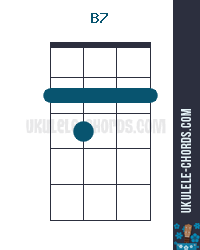
Reliable first-position shape: 2–3–2–2 (G–C–E–A).
- Middle: G string, 2nd fret
- Ring: C string, 3rd fret
- Index: mini-barre across E and A strings, 2nd fret
Alternate (quick change to E): 4–3–2–0. It’s bright and open, great for turnarounds, but mind the open A—control your strum to avoid booming the top string when you don’t want it.
The real problem: coordination, not finger strength
Most players press too hard and too flat, then chase dead notes by squeezing harder. Instead, aim for fingertip precision and small movements:
- Plant order (guitar): middle on A–2, index on D–1, ring on G–2, pinky on e–2. Strum each string slowly; correct the first buzzing string before moving on.
- Plant order (ukulele): index mini-barre first (E–A, 2nd fret), then middle (G–2), then ring (C–3). If the barre buzzes, roll the index slightly toward the nut-side edge of the finger for firmer contact.
- Micro-release: After you get a clean sound, relax pressure 10% while holding shape. Find the lightest touch that still rings. That’s your target tension.
Transitions that actually happen in songs
E to B7 (guitar, blues and rock)
From E major (0–2–2–1–0–0), lift everything except your index. Slide the index to D string, 1st fret, then drop middle (A–2), ring (G–2), pinky (e–2). Practice the move as two beats: anchor index on beat 1, place the other three on beat 2, strum on the ‘and’ of 2. Speed comes from nailing the index anchor instantly.
A to B7 (guitar)
From open A (x–0–2–2–2–0), think “diagonal”: middle jumps to A–2, index to D–1, ring to G–2, pinky to e–2. Keep wrist neutral; don’t drop the elbow. A small wrist rotation sets all four fingers faster than moving them one by one.
E7 to B7 (ukulele)
E7 is 1–2–0–2. Keep the index ready to barre E–A at the 2nd fret for B7. Transition becomes: add the ring to C–3 and middle to G–2 while the index rolls from a single note into a mini-barre. Your index is the hinge—treat it as home base.
Clean-up checklist (fast wins)
- Fret proximity: Get within 1–2 mm of the fretwire on D–1 (guitar) and C–3 (ukulele). Farther back = buzz.
- Finger angle: Curve fingers so the ring finger doesn’t choke the B string (guitar) or the index doesn’t collapse on the ukulele barre.
- Right-hand focus: Practice four-strum patterns that target just the needed strings. On guitar, aim for A–to–e; on ukulele, keep the stroke compact to avoid smashing the open A in alternate shapes.
- Mute the low E (guitar): Touch it with the tip or pad of the middle finger while fretting A–2. It’s free safety.
Apply it: mini progressions you’ll actually play
- Blues in E (guitar): E – A – E – E | A – A – E – E | B7 – A – E – B7. Start at 70 BPM, loop the last bar until B7 feels automatic.
- Ukulele turnaround: E – E7 – A – A7 | E – E7 – B7 – E. Use the 2–3–2–2 shape for B7 on the last bar for a confident cadence.
Ten-minute practice plan
- 1 min: Slow single-string checks on B7. No tempo, just clean tone.
- 3 min: Plant-order drills (see above). Eyes closed for the final minute.
- 3 min: E ↔ B7 transitions at 60–72 BPM. Count aloud; land B7 on beat 1.
- 2 min: Add a groove. Guitar: down–down–up, up–down–up. Ukulele: light down-up swing.
- 1 min: Micro-speed bursts—two clean bars at +10 BPM, then back down for accuracy.
Common mistakes and fixes
- Dead B string (guitar): Your ring finger on G–2 is leaning. Move the fingertip closer to the nail and angle wrist slightly toward the headstock.
- Buzzy high E (guitar): Pinky too far from the fret. Slide it right up to the fretwire; reduce pressure—pressing harder won’t help if placement is off.
- Inconsistent mini-barre (ukulele): Roll the index toward its bony edge and set it first, before adding other fingers. Practice five slow barres, lift, repeat.
- Strum chaos: Don’t fix a left-hand problem with a louder right hand. Diagnose string by string, then restore the strum.
Hear it and lock it in
Sometimes your hands need a sound reference. Play along with a simple walkthrough, then loop the tricky transition until your fingers stop ‘thinking’ and start landing:
Where to go next
Once B7 is clean, explore B9 or B13 for color, or try sliding B7 shapes up the neck for quick turnarounds. On ukulele, practice B7 resolving to E major and E minor to hear how the dominant wants to pull home in both moods.
Takeaway: Treat B7 as a coordination puzzle, not a strength test. Set the index anchor first, place the remaining fingers as a single unit, and build transitions you’ll encounter in real songs. Ten focused minutes a day will beat an hour of unfocused strumming every time.